

For the past years, we already know the GPON technology application on the Optical Distribution Network, we introduce the XG PON and the XGS PON today, which is evolved from GPON to XGPON and XGS-PON step by step. This year we developed a new 8 Port 10G Combo PON GPON OLT, which combined the GPON and XG(S)PON. We also called it 10G PON OLT. On the other words, 10G PON has two standards, that is XG PON and XGS-PON. Following we can see the difference and coexistence between GPON & XG(S)PON.
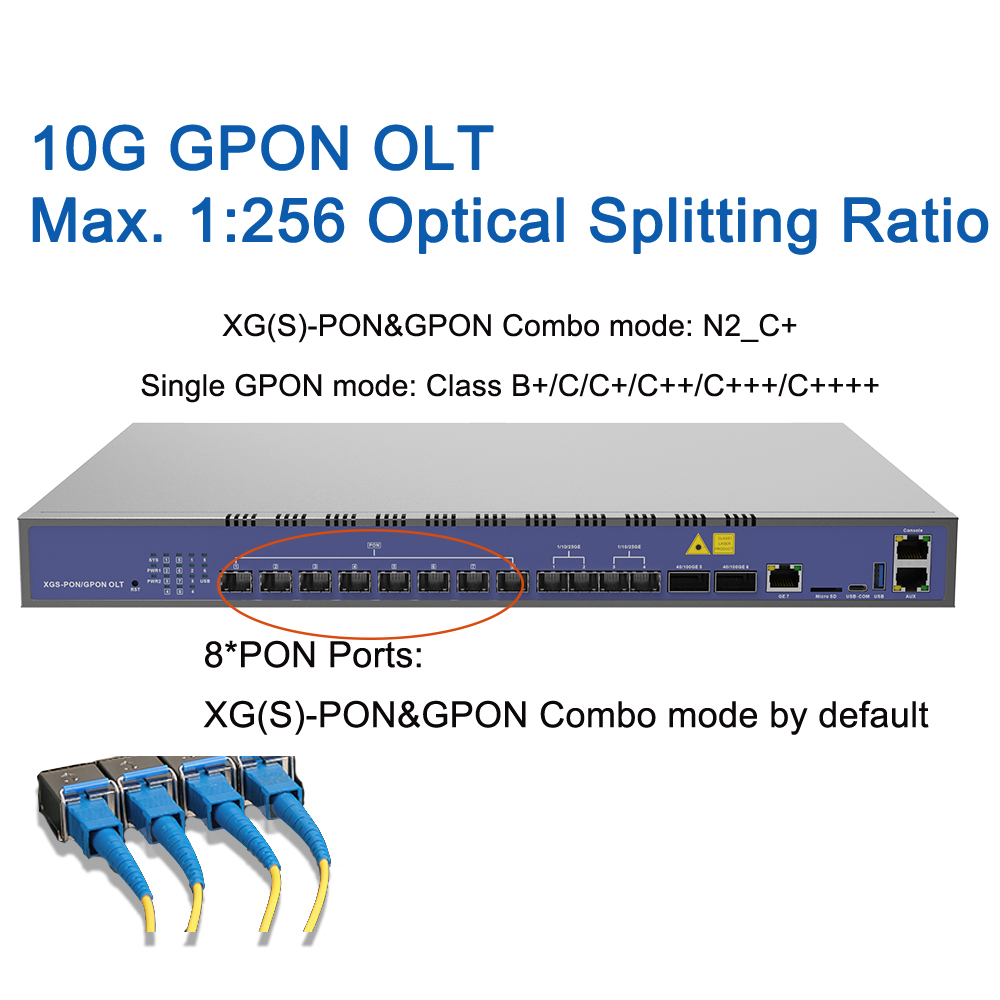
XG-PON OLT stands for XG-PON Optical Line Terminal. It's a component used in fiber-optic telecommunications networks, specifically within the XG-PON (10 Gigabit-capable Passive Optical Networks) framework. The "XG" in XG-PON indicates it supports data rates up to 10 Gbps (gigabits per second). The XG-PON standard offers both symmetric and asymmetric service options, meaning it can support equal speeds in both directions (symmetric) or different speeds in each direction (asymmetric). This technology can be used for upgrade the GPON technology. It can access to the GPON ONT, 10G PON ONT. XGS-PON can provide symmetrical data rates up to 10 Gbps upstream and downstream. XGS-PON is designed to coexist with existing GPON infrastructure, allowing service providers to gradually upgrade their networks.
| Specification | GPON | 10G PON | |
| XG-PON | XGS-PON | ||
| Wavelength | Downstream: 1480-1500 nm
Upstream:1290-1330 nm |
Downstream:1575-1580 nm
Upstream: 1260-1280 nm |
Downstream:1575-1580 nm
Upstream: 1260-1280 nm |
| PON Port Speed | Downstream: 2.488 Gbit/s
Upstream: 1.244 Gbit/s |
Downstream: 9.953 Gbit/s
Upstream: 2.488 Gbit/s |
Downstream: 9.953 Gbit/s
Upstream: 9.953 Gbit/s |
|
Maximum Split Ratio
(NOTE:The actual split ratio depends on the optical module model and fiber distance.)
|
1:128 | 1:256 | 1:256 |