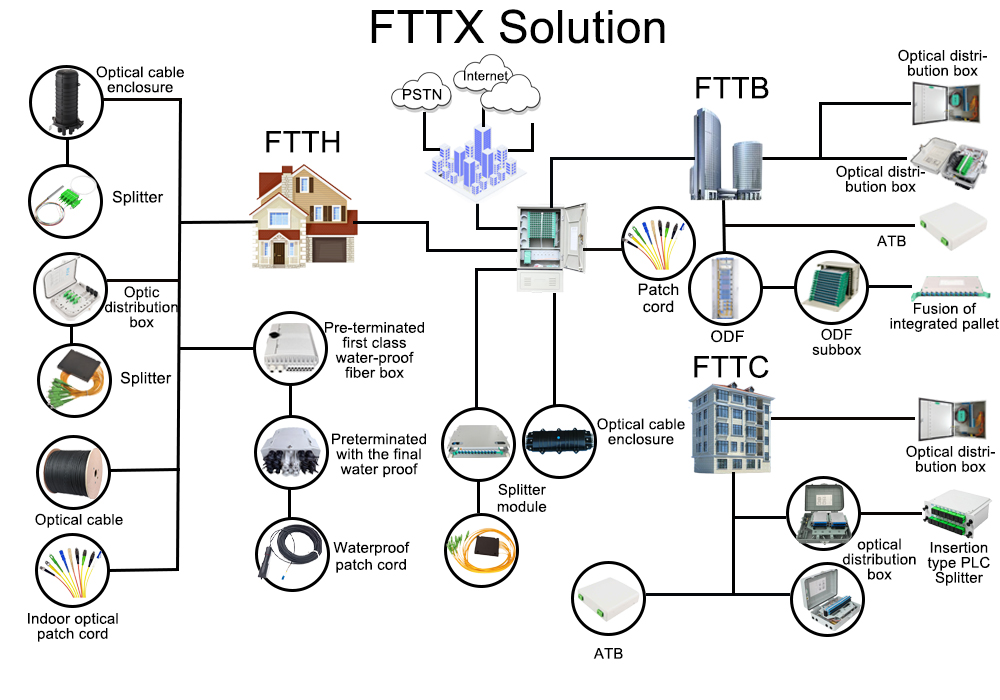
What is FTTX
Fiber to the x (FTTX; also spelled "fibre") , is a generalization for several configurations of fiber deployment, arranged into two groups: FTTP/FTTH/FTTB (fiber laid all the way to the premises/home/building) and FTTC/N (fiber laid to the cabinet/node, with copper wires completing the connection).is a generic term for any broadband network architecture using optical fiber to provide all or part of the local loop used for last mile telecommunications
The telecommunications industry differentiates between several distinct FTTX configurations. The terms in most widespread use today are:
FTTP (fiber-to-the-premises): This term is used either as a blanket term for both FTTH and FTTB, or where the fiber network includes both homes and small businesses
FTTB (fiber-to-the-building, -business, or -basement): Fiber reaches the boundary of the building, such as the basement in a multi-dwelling unit, with the final connection to the individual living space being made via alternative means, similar to the curb or pole technologies. It can currently reach symmetrical 10 Gbit/s with G.mgfast.
FTTH (fiber-to-the-home): Fiber reaches the boundary of the living space, such as a box on the outside wall of a home. Passive optical networks and point-to-point Ethernet are architectures that are capable of delivering triple-play services over FTTH networks directly from an operator's central office. Typically providing between 1 and 10 Gbit/s
FTTO (fiber-to-the-office): Fiber connection is installed from the main computer room/core switch to a special mini-switch (called FTTO Switch) located at the user's workstation or service points. This mini-switch provides Ethernet services to end user devices via standard twisted pair patch cords. The switches are decentralised and located all over the building, but managed from one central point
Fiber to the x is the key method used to drive next-generation access (NGA), which describes a significant upgrade to the broadband available by making a step change in speed and quality of the service. This is typically thought of as asymmetrical with a download speed of 24 Mbit/s plus and a fast upload speed. Ofcom have defined super-fast broadband as "broadband products that provide a maximum download speed that is greater than 24 Mbit/s – this threshold is commonly considered to be the maximum speed that can be supported on current generation (copper-based) networks.