

OLT, or Optical Line Terminal, is the service provider's endpoint device in a Passive Optical Network (PON), acting as the "heart" of a fiber optic network that connects the provider's core network to end-user devices (ONTs/ONUs). It converts electrical signals to optical signals for downstream transmission and receives optical signals for upstream transmission, enabling high-speed data, voice, and video services by managing and distributing signals to multiple users simultaneously
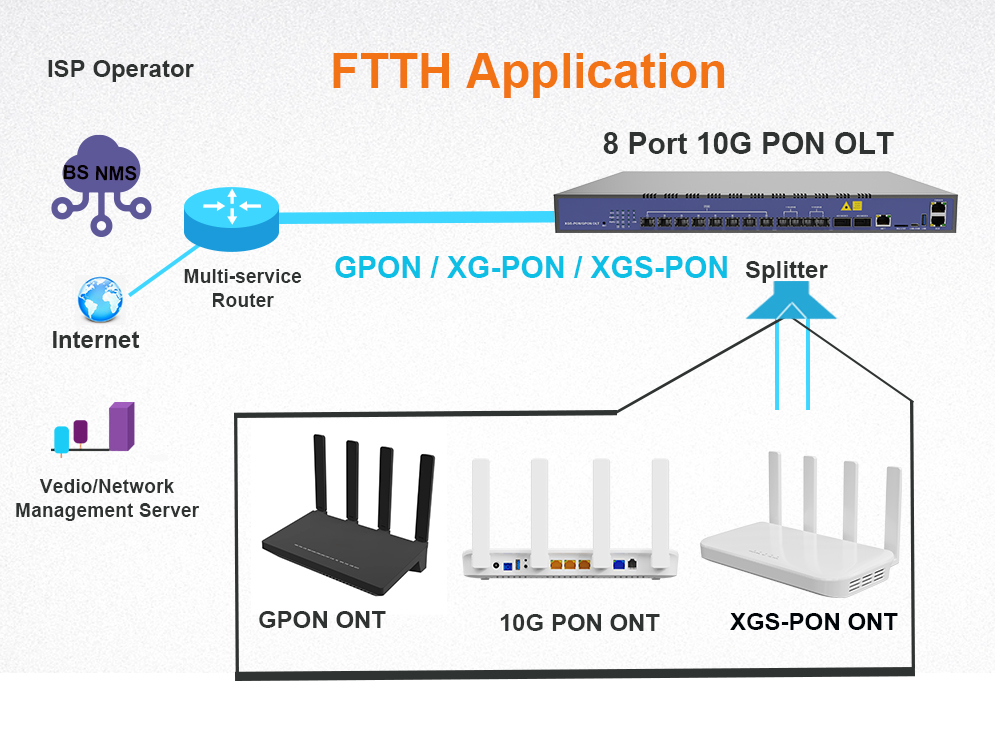
Key Functions of an OLT
Signal Conversion: Converts electrical signals from the core network into optical signals for fiber transmission and converts incoming optical signals back into electrical signals for the provider's network.
Network Management: Manages and monitors the PON network to ensure efficient and smooth data flow.
Bandwidth Allocation: Distributes bandwidth to multiple users, managing the sharing of the optical fiber line.
User Connection: Provides the interface between the core network and the end-user devices (ONTs or ONUs).
How it Works in a Fiber Network
Location: The OLT is located at the service provider's central office or a local facility.
Connection to Core Network: It connects to the ISP's core network via Ethernet cables.
Connection to Users: It transmits optical signals through fiber optic cables to Optical Network Units (ONUs) or Optical Network Terminals (ONTs) at users' homes or offices.
Bidirectional Communication: It handles the bidirectional flow of data, receiving user signals and sending service signals to users, forming a complete fiber-optic internet system.