

FTTH (Fiber to the Home) construction has become the core infrastructure of modern gigabit broadband transformation, covering urban residential areas, suburban communities and rural network upgrading projects. Traditional fiber laying and splicing work relies heavily on manual operation, which is prone to low precision, repeated rework and slow construction progress. Complex field environments, uneven fiber cutting and manual alignment errors often lead to excessive splicing loss, affecting network stability and project acceptance efficiency. With the continuous upgrading of communication equipment, intelligent splicing technology has thoroughly optimized the whole process of FTTH deployment, greatly improving overall construction speed and engineering quality.
Modern field FTTH projects put forward high requirements for portable and efficient construction tools, especially for scattered household access and outdoor wiring scenarios. The Handheld FTTx Fusion Splicer features miniaturized body design and low-power hardware configuration, perfectly adapting to mobile field operations. It is lightweight and easy to carry, allowing construction technicians to complete rapid wiring and splicing in narrow corridors, outdoor pole lines and remote construction sites. Compared with bulky traditional equipment, it saves a lot of carrying and layout preparation time, effectively accelerating the progress of large-scale household fiber access projects.
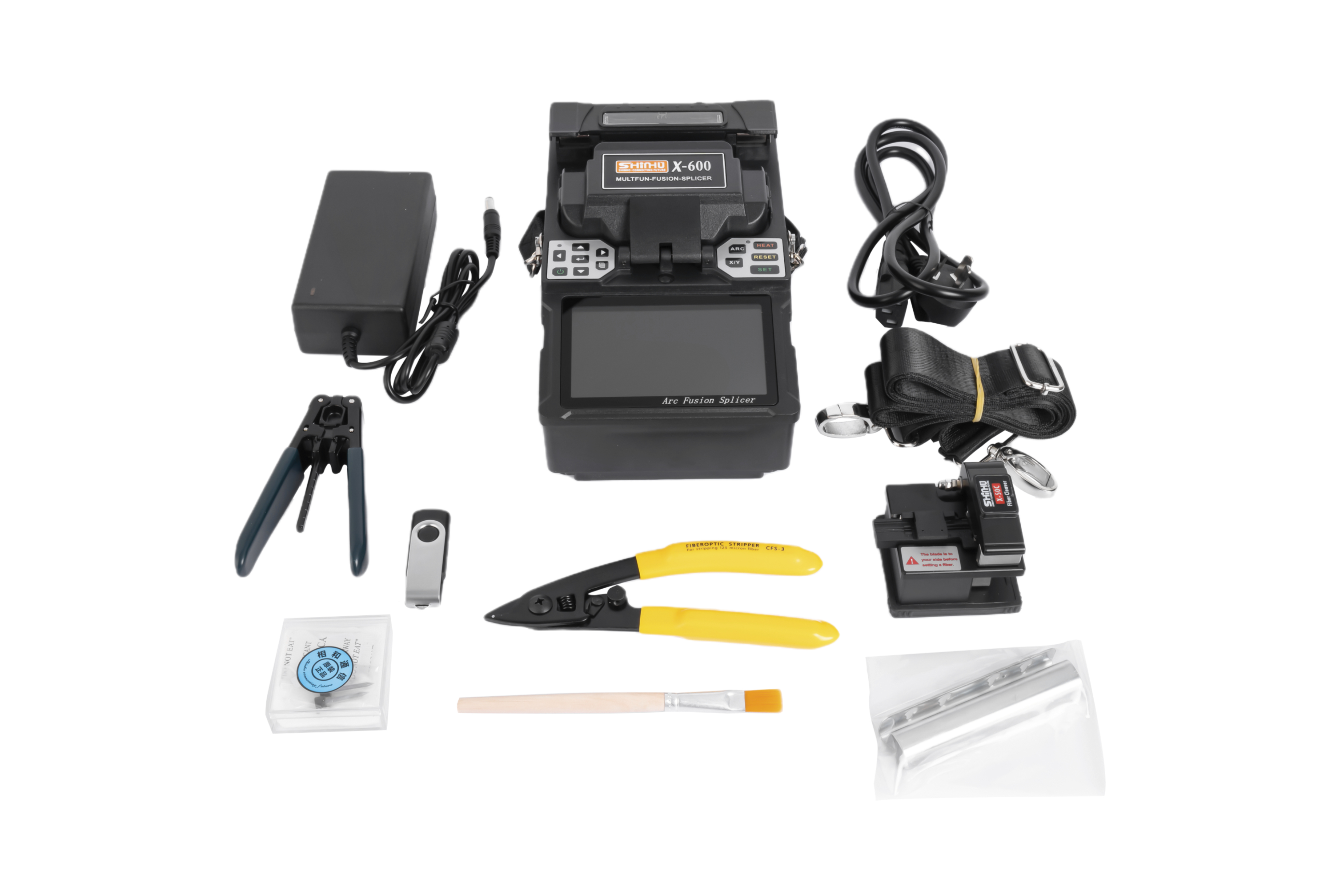
Splicing accuracy and stability directly determine the pass rate of FTTH engineering acceptance. Manual operation is easily affected by ambient temperature, humidity and human experience, resulting in inconsistent splicing quality. The automatic optical fiber fusion splicer adopts intelligent core alignment and real-time arc calibration technology. It can automatically identify fiber types, adjust splicing parameters and detect splicing loss data, eliminating manual operation errors. The intelligent heating and shrinkage control system ensures stable fiber joint quality, reduces rework rate caused by unqualified splicing, and effectively improves the one-time success rate of FTTH construction.
Intelligent algorithm optimization further empowers efficient large-scale network renovation and deployment. Equipped with built-in AI computing modules, the optical fiber fusion splicer ai-9 realizes intelligent whole-process operation from fiber clamping, alignment, fusion to heat shrinkage. It shortens the single splicing cycle to several seconds, realizing efficient batch construction. Meanwhile, it supports real-time data recording and intelligent fault judgment, helping construction teams quickly locate abnormal splicing problems, reduce manual detection costs, and greatly improve the overall operational efficiency of FTTH projects.
In addition to improving on-site construction efficiency, intelligent splicing equipment also reduces later network operation and maintenance pressure. High-precision splicing effectively controls signal transmission loss, ensuring long-term stable operation of household broadband networks. Standardized intelligent construction also unifies engineering quality standards, facilitating later network maintenance, fault troubleshooting and bandwidth upgrade transformation for operators.