

Modern network construction covers two core scenarios: long-distance trunk transmission and short-distance high-density data center interconnection. Different transmission distances, bandwidth requirements and cost budgets require matching fiber connection accessories. Improper selection will lead to excessive signal attenuation, bandwidth bottlenecks and frequent network faults. Distinguishing the performance gaps between single-mode and multimode fiber connection accessories becomes a basic standard for operators and system integrators to deploy reliable optical networks.
Short-distance interconnection inside server rooms and cabinet clusters demands low-cost, convenient wiring solutions. The Multimode Fiber Patch Cord adopts larger fiber core diameter, allowing light signals to transmit through multiple reflection paths inside the fiber. It is compatible with low-cost VCSEL transceivers, suitable for 10G, 40G and 100G short-range transmission within 550 meters. Data centers widely apply this product for horizontal wiring between racks, lowering overall project deployment expenses while meeting the concurrent transmission demands of massive computing nodes.
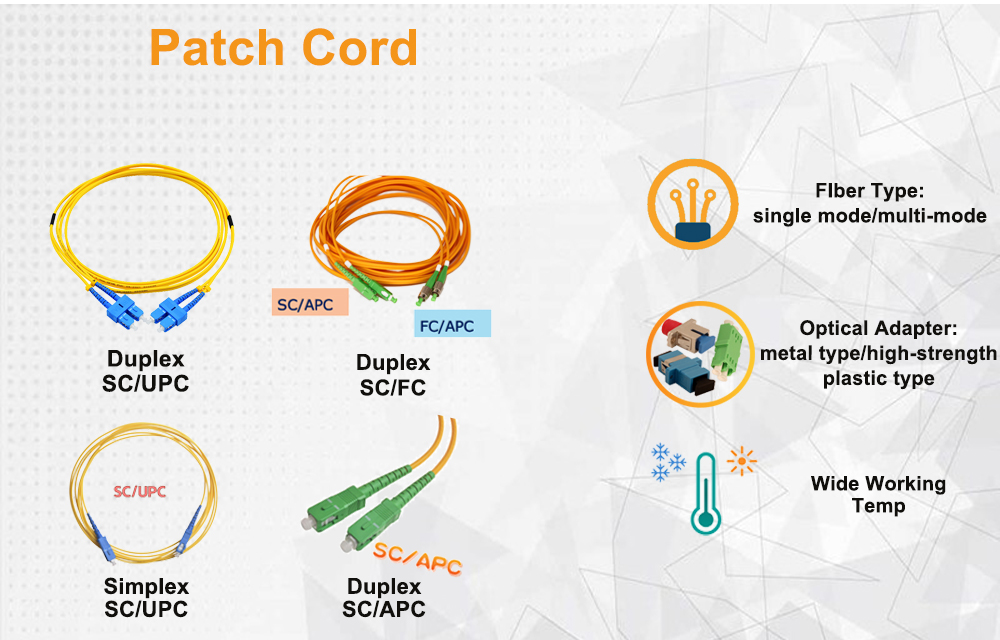
Long-distance communication projects such as urban trunk lines and cross-building optical links put forward strict standards for signal loss control. The Fiber Optic Patch Cord uses tiny single-mode fiber cores that only support straight light propagation, effectively reducing transmission loss over dozens of kilometers. It matches high-performance laser modules, stably supporting gigabit and terabit long-haul transmission without obvious signal decay. Telecom operators rely on this accessory to build backbone optical networks connecting base stations, computer rooms and regional communication hubs
Daily engineering maintenance and flexible temporary network expansion need lightweight, easy-to-store connection lines. The Patch cable features flexible outer sheath and customizable lengths, covering both single-mode and multimode fiber types. Construction teams carry a full set of such products for on-site testing, temporary equipment debugging and later network reconstruction. Its plug-and-play design greatly shortens wiring construction time, improving the overall deployment efficiency of both long-distance and data center optical networks.
Beyond transmission distance and cost gaps, the two categories differ greatly in bandwidth potential. Multimode types are limited by modal dispersion and cannot support ultra-long-distance high-speed signals, while single-mode variants maintain stable performance under 400G and 800G high-bandwidth standards. All three series of accessories adopt anti-bending fiber cores and wear-resistant shells, adapting to the complex wiring environment of equipment cabinets and outdoor pipeline layouts.