

Optical Receiver is a device used in optical communication systems. Its main function is to convert weak optical signals after optical fiber transmission into electrical signals and restore the original data. Its core task is to achieve signal regeneration with minimal additional noise and distortion. It is a key component in optical fiber communication links.
1. Core Data Features
Sensitivity
Measures the minimum input optical power acceptable to the receiver under a given bit error rate, usually in dBm.
Typical value: -28dBm to -40dBm, high-sensitivity devices can support longer transmission distances.
Bandwidth
Indicates the frequency range in which the detector can handle high-speed digital signals, in MHz or GHz.
Typical value: 45MHz-1000MHz (CATV application), high-end models can reach 20GHz (high-speed communication).
Dynamic Range
The difference between the maximum and minimum optical power that the receiver can handle, in dB.
Typical value: >30dB, ensuring stable operation under both strong and weak light conditions.
Power conversion efficiency (Efficiency)
Measures the ability to convert light energy into electrical energy, usually expressed in responsiveness (A/W).
Typical value: 0.8A/W-1.2A/W, high efficiency can reduce power consumption.
Noise characteristics
Including dark current noise, thermal noise, etc., which affect signal quality.
High-quality equipment optimizes the signal-to-noise ratio (SNR) through low-noise amplifiers (LNA) and filtering technology.
2. Type differentiation
By detection method
Direct detection optical receiver: no local oscillator laser is required, simple structure, low cost, suitable for medium and short distance communication.
Coherent detection optical receiver: requires local oscillator laser, high sensitivity, suitable for long-distance, high-speed communication (such as 100G/400G system).
By application scenario
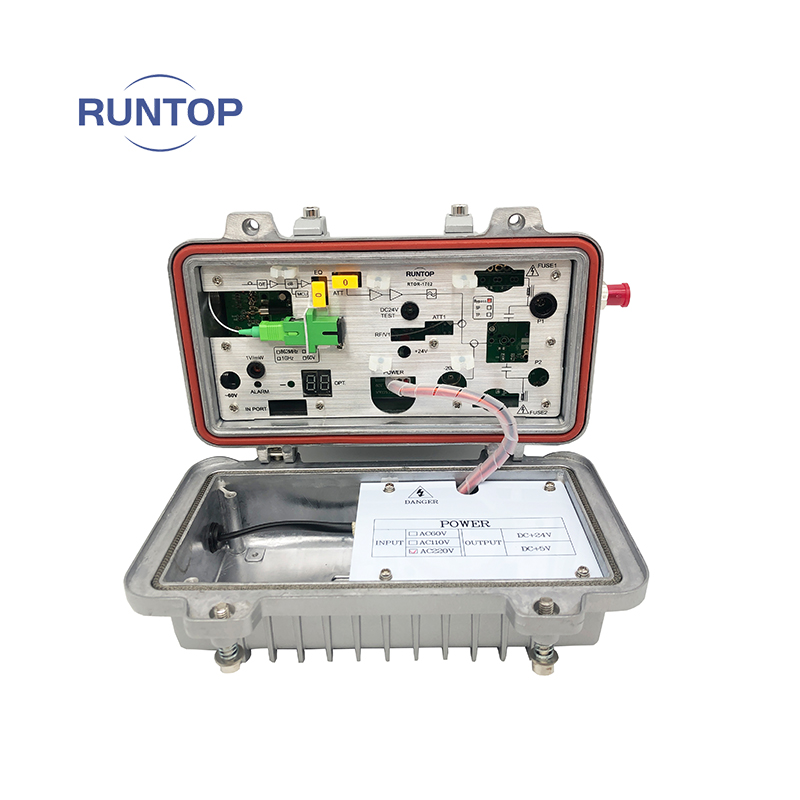
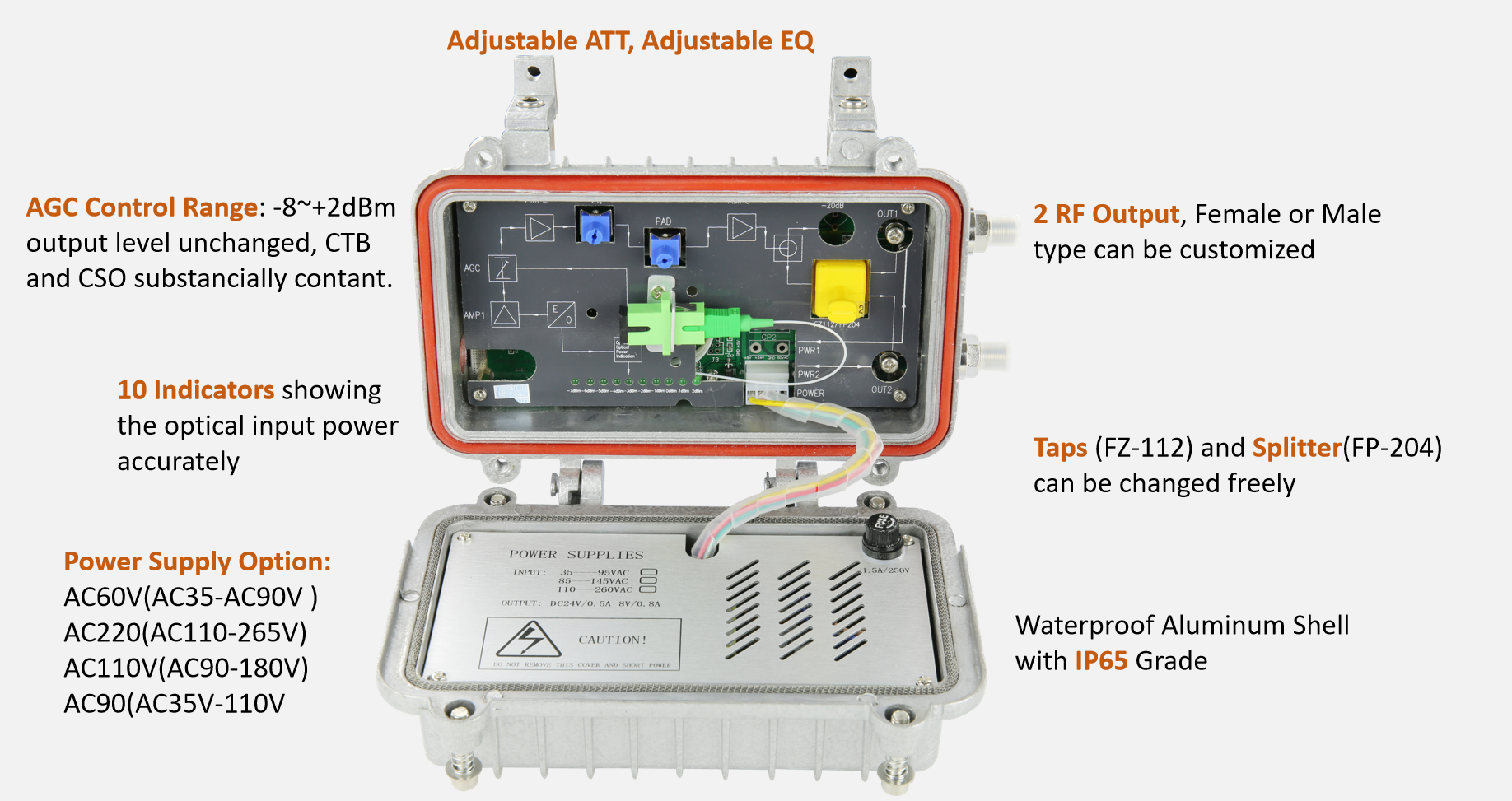
CATV optical receiver: supports 45-1000MHz bandwidth, output level 87-89dBuV, suitable for cable TV network.
FTTH optical receiver: supports XG(S)-PON protocol, operating wavelength 1310/1490/1550nm, suitable for fiber-to-the-home access.
Data communication optical receiver: supports high-speed digital signal processing, suitable for data center interconnection.
By interface type
SC/APC or FC/APC interface: suitable for single-mode optical fiber, low reflection loss (≥55dB).
F-female RF interface: suitable for CATV signal output.
3. Application scenarios
Fiber-optic communication network: used for optical signal reception and regeneration in backbone networks and metropolitan area networks.
Cable television (CATV): receives optical signals and converts them into RF signals, which are distributed to user terminals.
Fiber-to-the-home (FTTH): as part of the optical network unit (ONU), broadband access is achieved.
Data center interconnection: supports high-speed optical signal reception to meet the needs of cloud computing and big data.
4. Suitable for buyer analysis
Telecommunications operators
Recommended types: coherent detection optical receiver, FTTH optical receiver.
Procurement points: support long-distance transmission, high bandwidth, low bit error rate.
Cable TV service providers
Recommended type: CATV optical receiver.
Procurement points: support wide bandwidth, high output level, low noise.
Data center operators
Recommended type: high-speed data communication optical receiver.
Procurement points: support 100G/400G rate, low latency, high reliability.
System integrators
Recommended type: modular optical receiver, support customized configuration.
Procurement points: compatible with multiple protocols, easy to integrate, strong scalability.