

Optical transmitter and optical receiver: core functions and technical comparison
1. Core functions and appearance features
Optical transmitter: A device that converts electrical signals into optical signals and couples them into optical fibers. It is the "signal source" of the optical fiber communication system.
Appearance features:
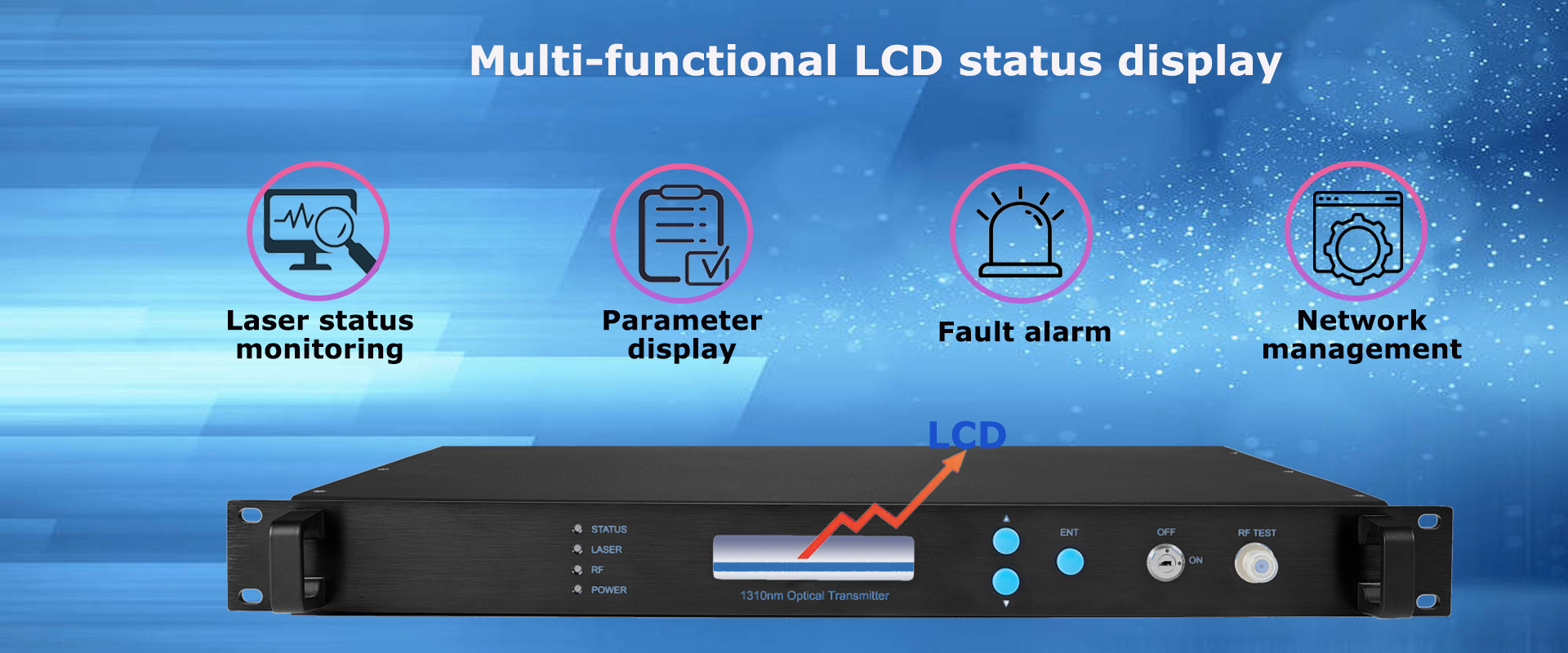
Modular design, usually 1U or 2U rack-mounted tray, easy to integrate into the optical terminal.
Core components include lasers (such as DFB lasers), drive circuits, temperature control modules (ATC) and optical power control circuits (APC).
The interface includes electrical signal input ports (such as RF, baseband), optical output interfaces (FC/APC connectors) and monitoring interfaces (RS485/network ports).
High-end models (such as external modulation optical transmitters) are equipped with microprocessors and LCD displays to monitor the working status in real time.
Core functions: electrical/optical conversion (E/O), signal loading is achieved by modulating the laser.
Modulation mode: direct modulation (low cost, rate limited) or external modulation (high rate, support for high-order formats such as M-QAM, M-PSK).
Performance advantages: high output optical power (such as +3dBm to +10dBm), supporting long-distance transmission.
Anti-interference ability: depends on the laser line width and modulation depth, and the external modulation type has strong anti-dispersion ability.
Cost and complexity: direct modulation type has low cost, and external modulation type requires additional modulators, which is more expensive.
Optical receiver: a device that converts weak optical signals after optical fiber transmission into electrical signals and restores the original information. It is the "signal end point" of the system.
Appearance features:
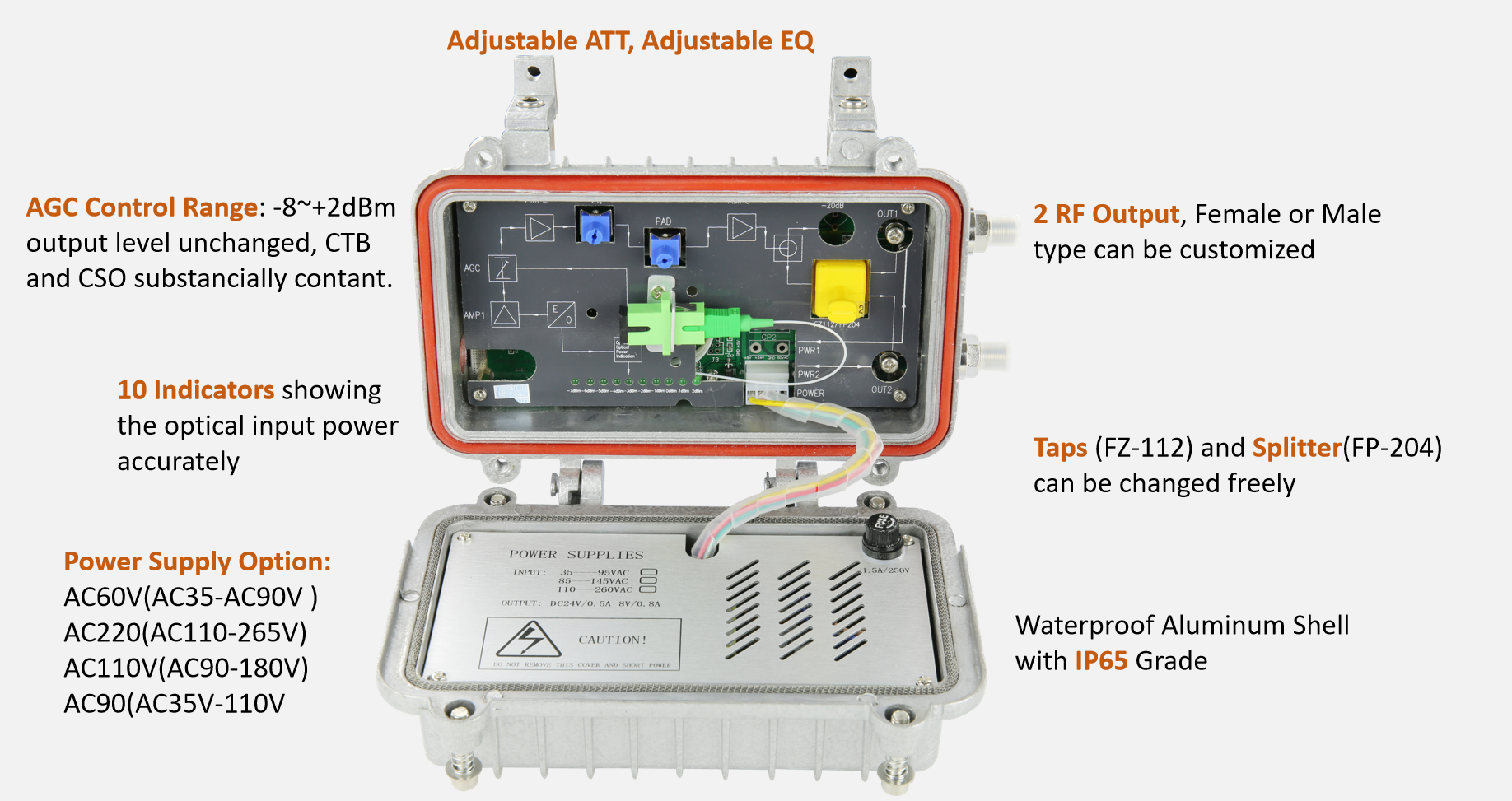
Compact design, commonly field or indoor chassis, with a protection level of IP65 or above.
Core components include photodetectors (PIN or APD diodes), preamplifiers, limiting amplifiers and demodulation circuits.
The interface includes an optical input port (SC/APC connector), an electrical signal output port (such as RF, Ethernet) and a status indicator (such as an eight-segment display of optical power level).
Some models use double shielding and waterproof sealing rings to adapt to harsh environments.
Core functions: optical/electrical conversion (O/E), signal demodulation through photodetectors.
Modulation mode: incoherent demodulation (power detection) or coherent demodulation (supports ASK, PSK, QAM, higher sensitivity).
Performance advantages: high sensitivity (up to -40dBm), support for weak signal detection; large bandwidth (supports 400G/800G high-speed transmission).
Anti-interference ability: coherent receivers compensate for dispersion and noise through digital signal processing (DSP), and the anti-interference ability is significantly improved.
Cost and complexity: incoherent type has low cost, coherent type requires local oscillator laser and DSP chip, which is more expensive.
2. Typical application scenarios
Optical transmitter
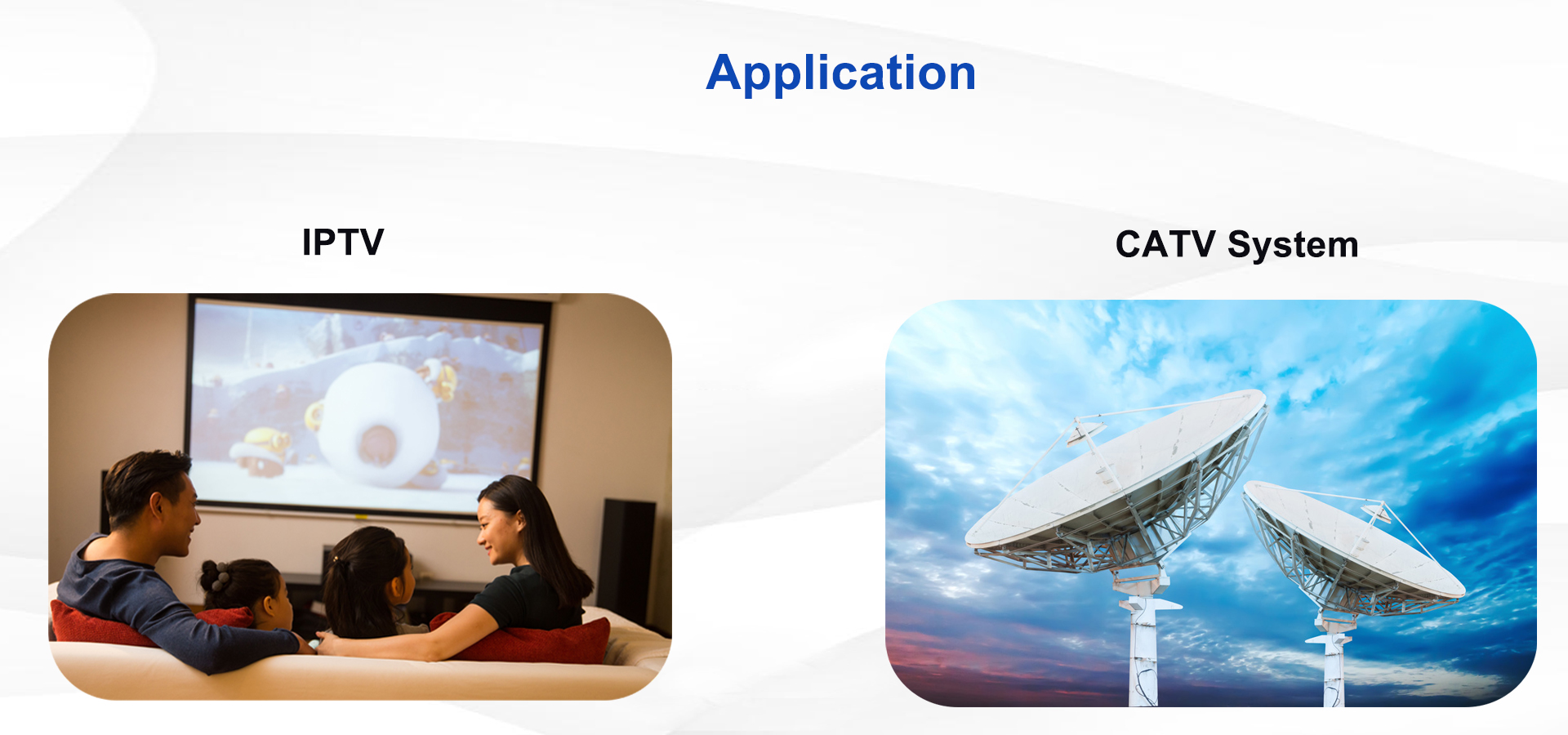
Broadcasting and television network: used for cable TV front end, transmitting CATV signals to the trunk line (such as FWT-1550ET series supports full-band transmission).
Data Center Interconnect (DCI): supports 400G/800G high-speed transmission to meet the needs of cloud computing and big data.
Long-distance trunk network: Transoceanic submarine optical cables use coherent optical transmitters to achieve single-wavelength 100G~800Gbps transmission.
Optical receiver
Urban optical network: Receive fiber-to-the-home (FTTH) signals and convert them into TV or network signals.
Field monitoring: Such as the HY-7330A series field optical receivers, suitable for optical node equipment in large and medium-sized networks.
5G fronthaul: Receive optical signals from base stations to the aggregation layer, supporting low-latency and high-reliability communications.
3. Comparison of key parameters
Optical transmitter: output optical power, modulation mode, line width, power consumption (such as <25W), size (290×205×113mm).
Optical receiver: sensitivity, bandwidth (such as 750MHz-862MHz upgradeable), overload optical power, interface type (such as SC/APC).
4. Purchasing and selection
Clear demand scenarios
Broadcasting/cable TV: give priority to optical transmitters that support full-band transmission and have high-quality low-frequency signals (such as DFB laser direct modulation type), matched with optical receivers with high sensitivity and excellent in-band flatness (such as HY-7330A series).
Data center/long-distance transmission: select externally modulated coherent optical transmitters (supporting high-order modulation and polarization multiplexing), matched with coherent optical receivers (with DSP compensation function).
Industrial/field environment: pay attention to the equipment's protection level (IP65+), operating temperature range (-40℃~60℃) and anti-electromagnetic radiation capability.