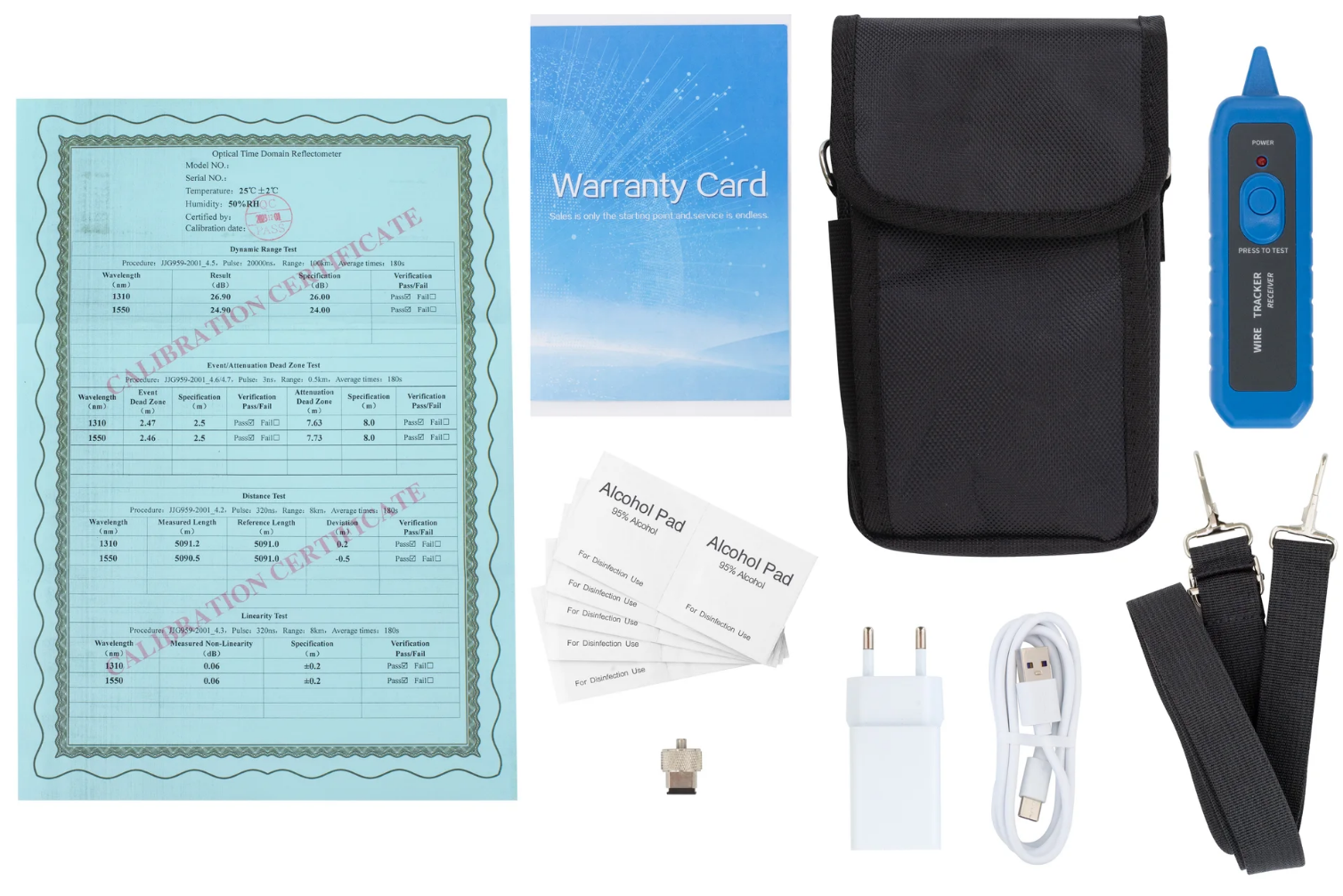
An OTDR (Optical Time Domain Reflectometer) is a precision instrument that uses the Rayleigh scattering and Fresnel reflection properties of light as it propagates through optical fibers to measure optical fiber performance by analyzing backscattered light signals. Its operating principle is similar to radar: short laser pulses are emitted into the fiber and the time delay and intensity of the reflected light are measured to create a loss profile along the fiber.
Rayleigh scattering: Caused by inhomogeneities in the optical fiber material (such as the lattice structure of quartz glass), it is a continuous, weak scattered signal used to measure the overall attenuation of the fiber.
Fresnel reflection: Strong reflection signals are generated by discrete events in the fiber (such as connections, breaks, and terminations) and are used to locate faults or features.
1. Appearance
Compact Design: Mainstream OTDRs are similar in size to small laptops and weigh approximately 2-5 kg, making them easy to carry in a handheld or backpack.
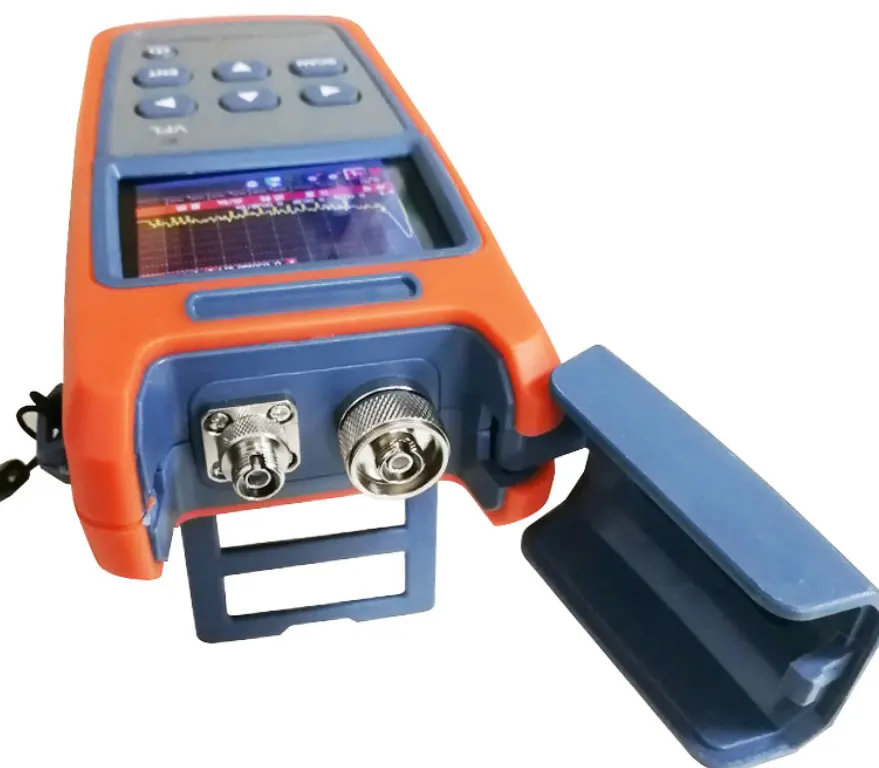
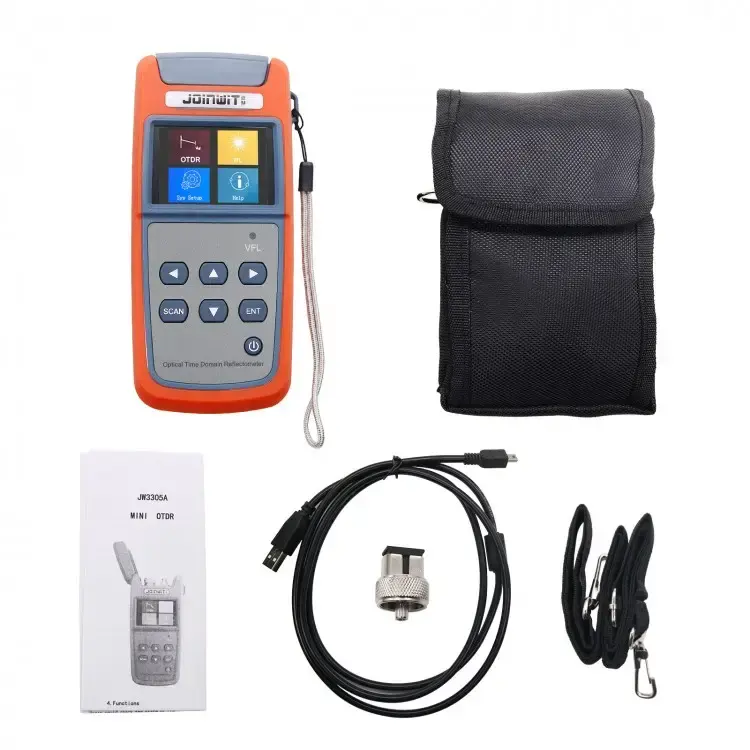
High-Resolution Display: Utilizing an anti-reflective LCD or touchscreen, these displays clearly display fiber profiles even in bright sunlight. Some models support zooming and panning gestures. Modular Interface: Equipped with interchangeable optical output heads (such as FC/APC, and SC connectors), it supports single-mode and multimode fiber testing. Select models include an integrated optical power meter and visual fault locator (VFL).
Durable Housing: Made of ABS or aluminum alloy, it is dustproof, waterproof (IP54 and above), and impact-resistant, making it suitable for harsh field environments.
Multiple Interface Expansion: USB and Ethernet interfaces are provided, supporting external USB flash drives, printers, and PC communication via software. Select models support remote control and data synchronization.
2. Function Types
Core Measurement Functions:
Fiber Length Measurement: Accuracy of up to ±1 meter, supporting calculation of the total length of single or multiple fiber segments.
Attenuation Analysis: Measures the average attenuation coefficient (dB/km) of optical fibers, supporting bidirectional testing to eliminate directional errors.
Fault Location: Locates connections, splices, or breaks using Fresnel reflection peaks with an accuracy of up to ±0.1 meter.
Event Dead Zone Optimization: An ultra-short event dead zone (≤1 meter) enables precise inspection of densely packed connectors or splices.
Intelligent Assistance Functions:
Automatic Test Mode: One-click start automatically completes trace acquisition, event analysis, and report generation.
Real-Time Monitoring: Supports online monitoring of fiber link status and automatic alarms when anomalies occur.
Data Management: Built-in large-capacity storage (supports thousands of test records) and supports export in Bellcore GR196 or SR-4731 file formats.
Advanced Functions:
Macrobend Detection: Locates fiber bends or pinch points by analyzing abnormal fluctuations in the scattering curve.
Dispersion Compensation: Select models support chromatic dispersion (CD) and polarization mode dispersion (PMD) measurements, suitable for high-speed optical networks.
Multi-Wavelength Testing: Supports switching between multiple wavelengths, including 1310nm, 1550nm, and 1625nm, to accommodate different fiber types and application scenarios.
3. Components
Laser Source: Emits short-pulse laser light (adjustable pulse width, e.g., 5ns-10μs) with wavelengths ranging from 1310nm to 1625nm, supporting testing of single-mode or multimode fibers. Optical Coupler: Directs transmitted light into the optical fiber and separates backscattered light to a detector, enabling bidirectional testing.
Photodetector: Utilizes a highly sensitive APD (avalanche photodiode) or PIN diode to convert weak optical signals into electrical signals.
Signal Processing Module: Includes a high-speed ADC (analog-to-digital converter) and FPGA (field-programmable gate array), enabling real-time acquisition, filtering, and event analysis of optical signals.
Control and Display System: Based on a WinCE or Linux operating system, it supports Chinese and English interfaces, touch operation, and shortcut key control. Some models also integrate a GPS module for geolocation.
Power Management: A built-in high-capacity lithium battery (3000mAh or higher) supports 8-12 hours of continuous operation and features a low-voltage alarm function.
4. Differences from OLTs: The essential differences between test equipment and network equipment
Functional Positioning:
OTDR: Focuses on physical layer testing of optical fiber links, such as loss, length, and fault location, and is an essential tool during construction and maintenance. OLT (Optical Line Terminal): As the core equipment in a PON (Passive Optical Network), it is responsible for signal aggregation and distribution, supporting user access and service management, and is considered network operations equipment.
Application Scenarios:
OTDR: Used for fiber installation acceptance, regular inspections, and troubleshooting to ensure link quality meets standards.
OLT: Deployed in the operator's equipment room, it connects the core network with the user-side ONU (Optical Network Unit), enabling the transmission of broadband, voice, video, and other services.
Technical Parameters:
OTDR: Core parameters include dynamic range (e.g., 45dB), event dead zone, and wavelength, which directly impact test accuracy and distance.
OLT: Key parameters include the number of PON ports, downstream bandwidth (e.g., 10G PON), and user capacity, which determine network coverage and performance.
5. Application Areas
Fiber-optic Communication Networks:
New Network Acceptance: Verify that fiber continuity, loss, and length meet design requirements.
Regular Maintenance: Detect issues such as fiber aging, loose connectors, and degraded splices to prevent service interruptions. Troubleshooting: Quickly locate breakpoints or high-loss points, shortening repair time (e.g., from hours to minutes).
Local Area Networks and Data Centers:
Test short-distance multimode fiber links to ensure the stability of high-speed data transmission (such as 40G/100G Ethernet).
Engineering Applications:
Railway/Highway Communications: Monitor the health of long-distance fiber lines to ensure driving safety.
Oil/Gas Pipelines: Use distributed fiber optic sensing technology to monitor pipeline parameters such as temperature and strain in real time to prevent leaks or damage.
Research and Education: Used for fiber optic material research, optical device performance testing, and educational experiments, supporting the development of talent in optical communications technology.
Shenzhen Runtuo Technology Co., Ltd. develops and provides a comprehensive suite of HFC and FTTH network products, encompassing cable TV headends, transmission, and terminal products, as well as fiber optic transmission equipment. We have a dedicated team dedicated to supporting every customer. Our dedicated R&D team of over 100 engineers possesses extensive experience in FTTH and HFC communications, including both software and hardware design. We also offer OEM or ODM services based on customer preferences and product ideas, working together to transform ideas into reality. We are your unwavering support!