

As the global demand for high-speed broadband continues to grow, both urban and rural areas are accelerating the construction of fiber optic networks to bridge the digital divide. GPON (Gigabit Passive Optical Network) and EPON (Ethernet Passive Optical Network) OLT (Optical Line Terminal) devices have become the core of broadband access networks, with their flexible deployment, high bandwidth efficiency, and cost-effectiveness making them ideal for diverse urban and rural scenarios. These devices serve as the central hub connecting operators’ core networks to end users, adapting to the different bandwidth needs, geographical characteristics, and service requirements of urban and rural broadband, and laying a solid foundation for universal high-speed connectivity.
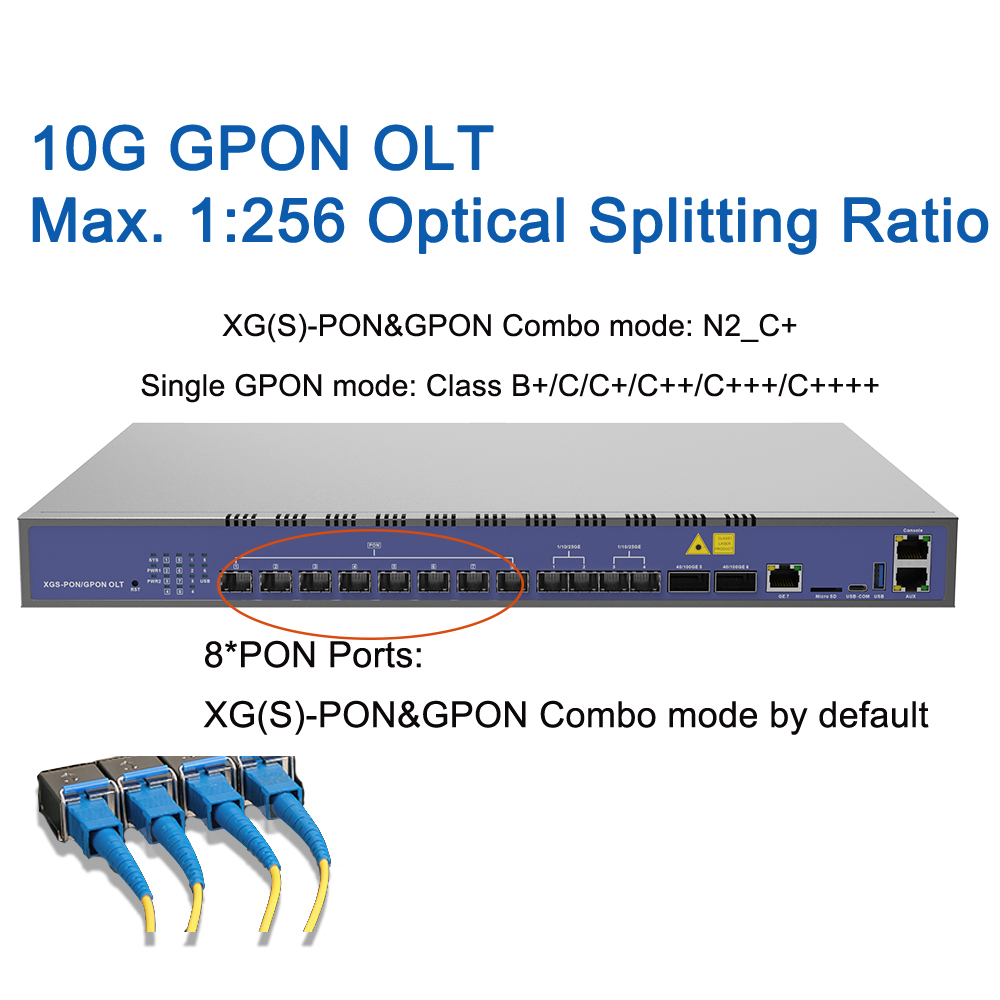
In urban areas, where user density is high and bandwidth demands are diverse, GPON EPON OLT devices play a key role in supporting high-concurrency, multi-service access. Urban households and businesses require stable bandwidth for 4K/8K video streaming, cloud computing, remote work, and smart city applications, while commercial districts and office buildings need to carry large-scale terminal access. The gpon 8port olt is widely adopted in urban deployments due to its high port density, which allows a single device to connect dozens of optical splitters and hundreds of end users, effectively reducing the cost of equipment and fiber deployment in dense urban areas. Its support for 10G-PON and XGS-PON upgrades also ensures that urban broadband networks can keep up with the growing demand for gigabit and even 10-gigabit speeds, supporting the seamless operation of smart home and digital office services.
Urban broadband networks also emphasize flexibility and scalability, as urban areas often face network expansion needs due to population growth and urban renewal. GPON EPON OLT devices support modular design, allowing operators to add ports or upgrade modules without disrupting existing services. This scalability is particularly important for urban areas where network traffic fluctuates greatly during peak hours, as the OLT can dynamically allocate bandwidth to ensure stable connectivity for all users. Additionally, urban OLT deployments are often integrated with smart network management systems, enabling remote monitoring and fault diagnosis, which reduces operational costs and improves service efficiency for operators.
In rural areas, the challenges of broadband deployment lie in low user density, long transmission distances, and limited infrastructure investment. GPON EPON OLT devices address these challenges with their long-distance transmission capabilities and cost-effective deployment models. The 4port epon olt is well-suited for rural scenarios, featuring a compact design, low power consumption, and easy installation, which makes it ideal for deployment in small rural central offices or outdoor cabinets. It supports long-distance signal transmission of up to 20km without significant signal loss, eliminating the need for expensive signal amplification equipment and reducing the cost of rural broadband construction.
Rural broadband services often focus on basic internet access, rural e-commerce, and agricultural informatization, and GPON EPON OLT devices can meet these needs with their stable performance and multi-service support. They can carry both data services and basic voice and video services, helping rural users access online education, telemedicine, and agricultural technical guidance. Moreover, the passive design of PON networks (supported by OLT devices) reduces the need for on-site maintenance, which is crucial for rural areas where technical personnel are scarce. This reliability ensures that rural users can enjoy consistent broadband services, narrowing the digital gap between urban and rural areas.
Another key advantage of GPON EPON OLT in both urban and rural broadband is their compatibility with various optical modules, which enhances their adaptability to different deployment environments. Theepon olt sfp module is a critical accessory that enables OLT devices to adjust transmission distances and signal strengths according to specific needs. In urban areas, SFP modules with short transmission distances and high bandwidth are used to meet dense user access, while in rural areas, long-distance SFP modules are adopted to cover remote villages, ensuring that OLT devices can adapt to the diverse geographical conditions of urban and rural areas.