

As 5G networks continue to penetrate global markets and 10G-PON technology becomes the mainstream for high-speed broadband, the demand for high-precision, efficient, and intelligent fiber optic test equipment is growing exponentially. The fiber optic test equipment, a core tool for ensuring the stability and reliability of fiber communication networks, is undergoing a comprehensive transformation to adapt to the evolving needs of telecom operators, data centers, and enterprise networks. Its future development is closely linked to the upgrading of fiber communication technologies, with key trends focusing on intelligence, miniaturization, and integration, while cooperating with supporting tools to better serve the entire fiber communication ecosystem.
Intelligence has become the core direction of the future development of fiber optic test equipment, reshaping how network testing and maintenance are conducted. Unlike traditional manual test tools that rely heavily on professional operators for operation and judgment, the smart Optical Power Meter leads this transformation by integrating AI algorithms and cloud connectivity. It enables real-time monitoring of optical signal strength, automatic calibration of test parameters, and remote data transmission to a centralized management platform. This smart device can automatically identify abnormal signal fluctuations, send timely early warnings, and significantly reduce the difficulty of network maintenance and the cost of manual operations, making fiber network testing more accessible and efficient.
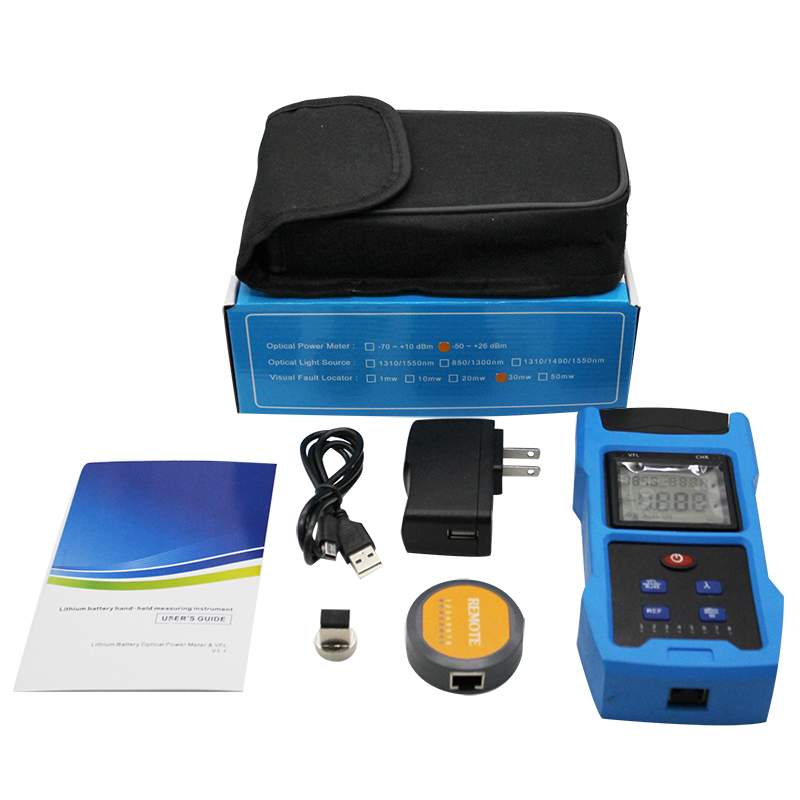
Miniaturization and portability are another critical trend, driven by the widespread application of on-site testing in diverse environments. With the expansion of FTTH networks to remote rural areas and the dense deployment of 5G base stations in complex urban and mountainous regions, test equipment needs to be lightweight, compact, and easy to carry. The fiber stripper, a key supporting tool for fiber preparation before testing, is also evolving toward miniaturization and high precision. Future fiber strippers will adopt hardened high-carbon steel blades, capable of precisely stripping the outer jacket, buffer layer, and cladding of fiber cables without scratching the fragile fiber core, laying a solid foundation for accurate testing results.
The integration of test functions and adaptation to next-generation network technologies are also shaping the future of fiber optic test equipment. As 10G-PON, XGS-PON, and other high-speed fiber technologies become more prevalent, test equipment must be compatible with higher bandwidths and more complex network environments. Meanwhile, with the continuous upgrading of Ethernet passive optical networks, the layer 3 epon olt imposes higher requirements on test equipment performance. Future fiber optic test equipment will be deeply integrated with layer 3 epon olt, realizing real-time synchronization of test data and network operation status, helping operators quickly locate network faults and optimize overall network performance.
Cost-effectiveness and technological innovation will further drive the development of fiber optic test equipment. Against the backdrop of global supply chain adjustments, manufacturers are focusing on developing high-performance, cost-efficient test tools to meet market demands. This includes optimizing core components and streamlining production processes to reduce costs without compromising quality. Such advancements will make high-precision fiber testing accessible to more operators, especially small and medium-sized telecom companies, promoting the popularization of fiber networks in underserved regions.