

Field-assembled fiber connection solutions have become indispensable for last-mile fiber deployment, broadband maintenance and temporary network reconstruction. Unlike factory prefabricated fiber links, on-site manual termination is easily affected by operating habits, environmental dust and irregular processing steps, resulting in excessive insertion loss and return loss. High signal loss will lead to unstable broadband transmission, network delay and even frequent disconnection, seriously affecting the service quality of FTTH, campus and enterprise optical networks. Mastering standardized installation specifications is the core to maximize the transmission performance of on-site fiber connection equipment.
The cleaning and pretreatment of fiber end faces is the primary step to control signal loss in field construction. Dust, oil stains and tiny scratches on the fiber surface are the main causes of increased optical signal attenuation. The sc apc fast connector adopts an angled physical contact design, which puts forward higher requirements for end-face cleanliness. Constructors need to use professional fiber cleaning wipes and alcohol cotton for deep cleaning before assembly, and avoid touching the fiber core with bare hands. Standardized pretreatment can effectively eliminate micro-gap light leakage, maintaining ultra-low loss transmission of optical signals in household and community fiber access scenarios.
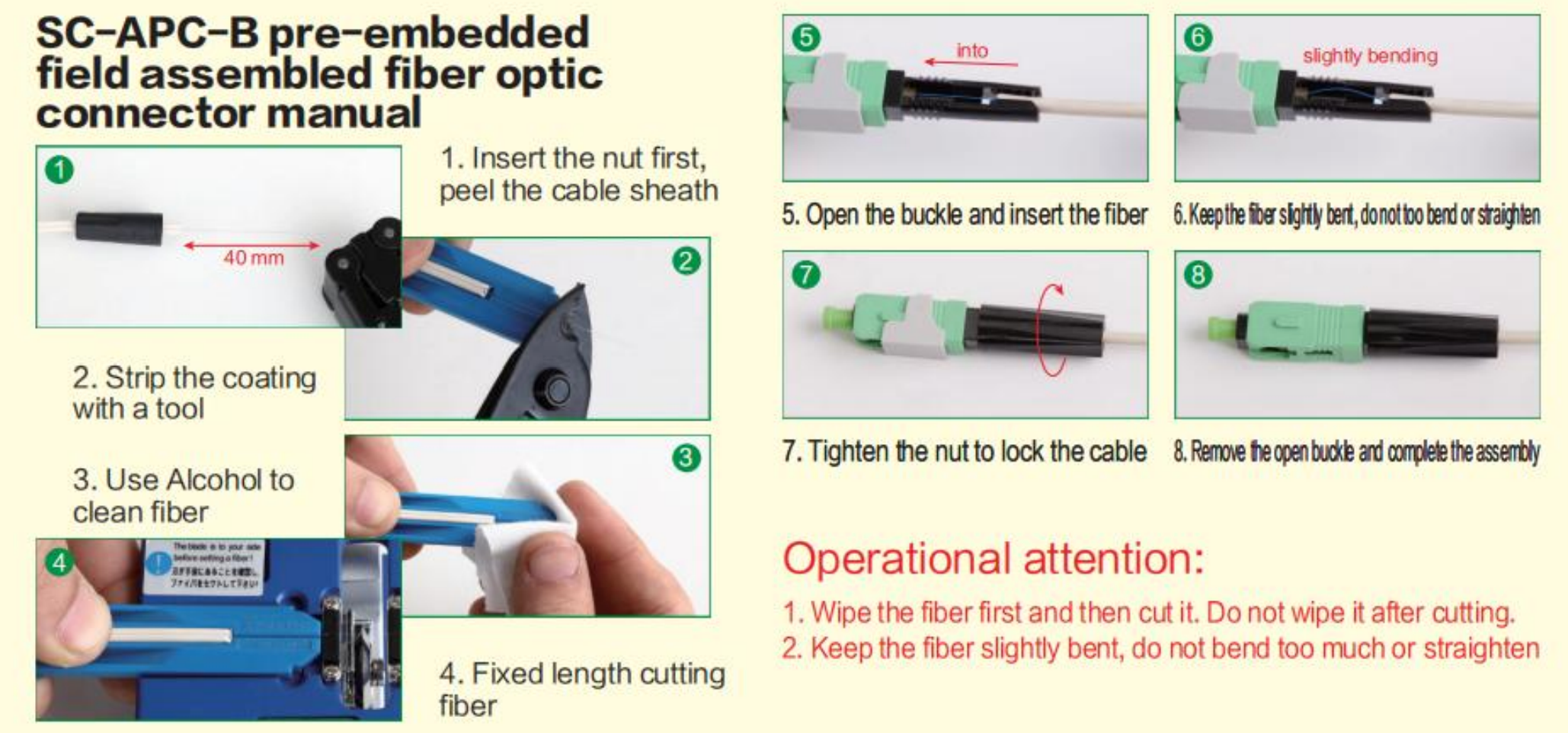
Precise fiber stripping and length calibration determine the fitting accuracy of on-site connections. Many construction quality problems stem from uneven stripping length, damaged fiber cladding and inappropriate cutting flatness. The sc upc fast connector features a flat physical contact structure, which requires strictly consistent fiber cutting angle and reserved length. Operators need to use high-precision fiber cleavers for cutting, ensure smooth and crack-free end faces, and strictly follow the equipment calibration standards for assembly. Scientific cutting and calibration operations greatly reduce the fitting gap between fiber cores and effectively suppress signal reflection and attenuation.
Standardized docking and fixed protection further optimize the long-term stability of fiber links in complex scenarios. Outdoor construction, corridor wiring and equipment cabinet deployment are often disturbed by vibration and temperature changes, leading to loose connector docking and increased loss over time. The Single Mode Connector used in long-distance and high-precision optical networks requires in-place locking and reinforced fixing after docking. Constructors should avoid excessive bending and extrusion of fiber jumpers, and use protective sleeves for encapsulation. This standardized protection method prevents structural displacement of connectors caused by external interference, ensuring long-term low-loss operation of fiber links.
In addition to standardized operations, environmental control is also crucial for field assembly. Construction in dusty, humid or low-temperature environments will easily affect the connection accuracy. It is necessary to carry out assembly work in a clean and dry environment as much as possible, and conduct loss testing with optical power meters after construction. Timely detection and adjustment of unqualified connections can avoid hidden dangers of long-term network operation.
To sum up, standardized installation processes are the key to reducing signal loss of field-assembled fiber connections. Scientific end-face cleaning, precise cutting calibration and standardized fixed protection can give full play to the performance advantages of fast connection equipment. These best practices effectively reduce network failure rates, improve fiber transmission efficiency, and provide reliable quality guarantee for large-scale on-site optical network construction and daily maintenance.