

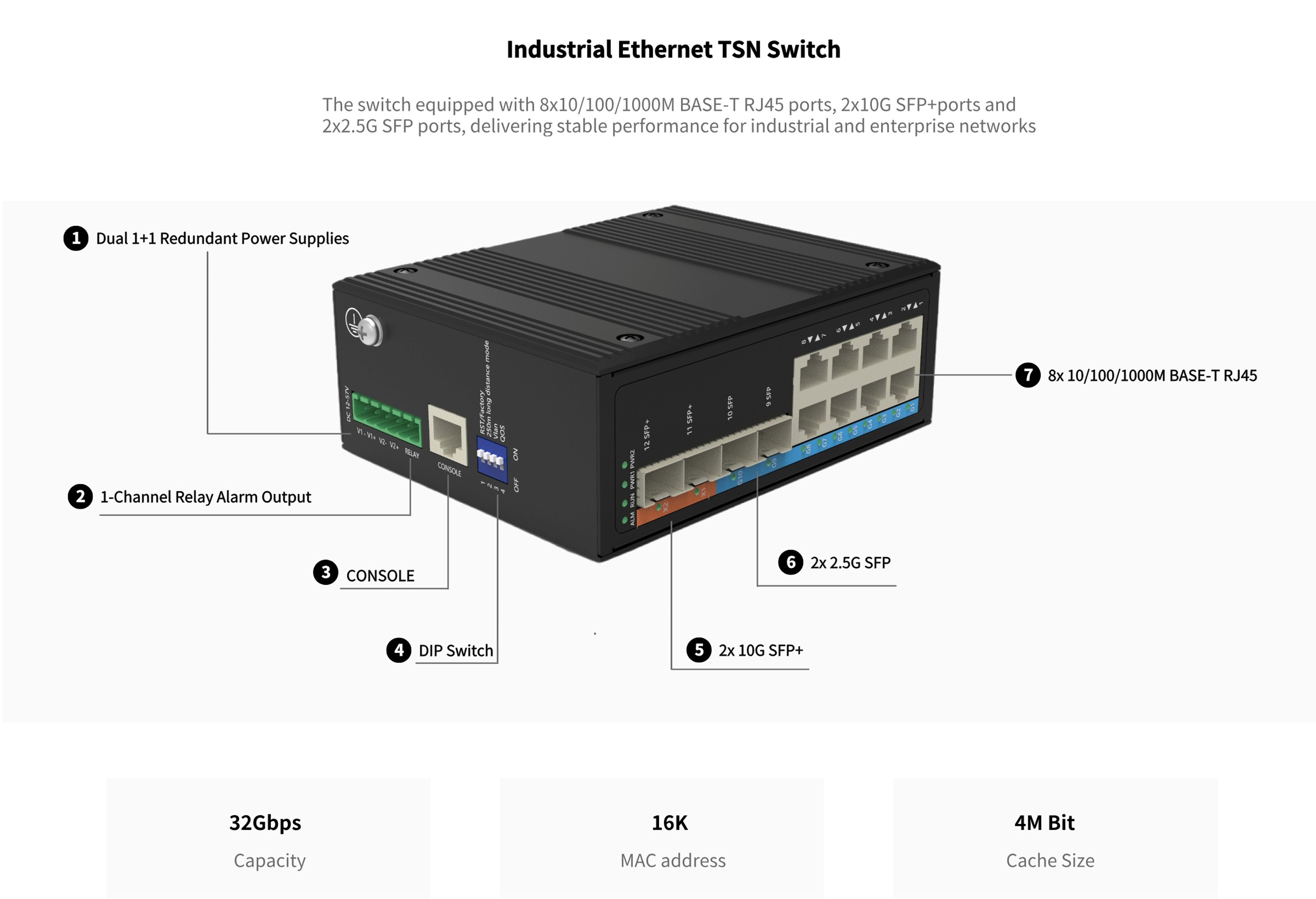
While both types of switches perform the fundamental task of routing data packets between devices on a network, industrial switches differ in several key ways:
-
Extreme Temperature Tolerance: Standard office switches operate safely between0℃ and 40℃ . Industrial switches are rated for extreme ranges, typically from -40℃–75℃or higher.
-
Rugged Housing & Fanless Design: They feature heavy-duty metal enclosures with High Ingress Protection (IP) ratings (such as IP30 or IP67) to keep out dust and water. Most use passive fanless cooling to avoid mechanical failure caused by airborne debris.
-
Redundancy and Reliability: Industrial networks cannot afford downtime. These switches utilize rapid ring-redundancy protocols (like ERPS or RSTP) that can reroute data traffic in milliseconds if a cable breaks or a node fails.
-
Electromagnetic Immunity (EMC/EMI): They are shielded against high electromagnetic interference commonly emitted by heavy machinery, motors, and high-voltage power lines.
-
DIN-Rail Mounting: Designed to be mounted directly inside industrial cabinets using standard DIN-rail mounts.
Key Applications of Industrial Switches
Because of their durability and high reliability, industrial switches form the backbone of critical infrastructure across numerous industries:
1. Industrial Automation and Smart Manufacturing
In Industry 4.0 environments, factory floors rely on real-time data exchange between Programmable Logic Controllers (PLCs), robotic arms, sensors, and Human-Machine Interfaces (HMIs). Industrial switches ensure low-latency communication and zero packet loss, which is essential for precise assembly lines and safety systems.
2. Intelligent Transportation Systems (ITS)
Modern transportation relies heavily on networked systems exposed to outdoor elements:
-
Railways & Subways: Used on trains and along tracks for signaling, passenger Wi-Fi, onboard surveillance, and automated train control systems.
-
Traffic Management: Connecting roadside traffic cameras, electronic message boards, and dynamic traffic lights across cities.
3. Energy, Power & Utilities
Power substations, wind farms, solar fields, and oil & gas facilities present extreme conditions, including high voltage, severe thermal variation, and explosive hazards (requiring Class 1, Div 2 certifications). Industrial switches manage Smart Grid communications, pipeline monitoring, and renewable energy storage systems.
4. Surveillance and Security (PoE Applications)
Industrial Power over Ethernet (PoE) switches deliver both data and high-wattage power through a single cable to outdoor IP surveillance cameras, access control panels, and perimeter detectors—even in remote or weather-exposed locations.
5. Smart Cities and Municipal Infrastructure
From automated water treatment plants to smart street lighting, municipalities use industrial switches to centralize monitoring, conserve resources, and maintain public utility uptime.