

Fiber optic splitter is a passive optical device that can split or separate an incident light beam into two or more light beams. Basically, there are two types of optical fiber splitter classified by their working principle: FBT splitter (fused biconical taper splitter) and PLC splitter (planar lightwave circuit splitter).
The Plc Splitter
PLC splitter is based on planar lightwave circuit technology. It comprises three layers: a substrate, a waveguide, and a lid. The waveguide plays a key role in the splitting process which allows for passing specific percentages of light. So the signal can be split equally. In addition, PLC splitters are available in a variety of split ratios, including 1:4, 1:8, 1:16, 1:32, 1:64, etc. They also have several types, such as bare PLC splitter, blockless PLC splitter, fanout PLC splitter, mini plug-in type PLC splitter, etc.
Advantage
The Plc Splitter
PLC splitter is based on planar lightwave circuit technology. It comprises three layers: a substrate, a waveguide, and a lid. The waveguide plays a key role in the splitting process which allows for passing specific percentages of light. So the signal can be split equally. In addition, PLC splitters are available in a variety of split ratios, including 1:4, 1:8, 1:16, 1:32, 1:64, etc. They also have several types, such as bare PLC splitter, blockless PLC splitter, fanout PLC splitter, mini plug-in type PLC splitter, etc.
Advantage
1.Suitable for multiple operating wavelengths (1260nm - 1650nm).
2.Equal splitter ratios for all branches.
3.Compact configuration, smaller size, small occupation space.
4.Good stability across all ratios.
5.High quality, low failure rate.
Disadvantage
Disadvantage
1.Complicated production process.
2.Costlier than the FBT splitter in the smaller ratios.
The FBT Splitter
FBT splitter is based on traditional technology, involving the fusion of several fibers from the side of each fiber. The fibers are aligned by heating them at a specific location and length. Due to the fragility of the fused fibers, they are protected by a glass tube made of epoxy and silica powder. Subsequently, a stainless steel tube covers the inner glass tube and is sealed with silicon. As technology continues to develop, the quality of FBT splitters has significantly improved, making them a cost-effective solution.
Advantage
The FBT Splitter
FBT splitter is based on traditional technology, involving the fusion of several fibers from the side of each fiber. The fibers are aligned by heating them at a specific location and length. Due to the fragility of the fused fibers, they are protected by a glass tube made of epoxy and silica powder. Subsequently, a stainless steel tube covers the inner glass tube and is sealed with silicon. As technology continues to develop, the quality of FBT splitters has significantly improved, making them a cost-effective solution.
Advantage
1.FBT splitter is made out of materials that are easily available and low-price, so it is cheaper.
2.Splitter ratios can be customized.
Disadvantage
Disadvantage
1.Restricted to its operating wavelength (850nm, 1310nm, and 1550nm).
2.The maximum insertion loss will vary depending on the split and increase substantially for those splits over 1:8.
3.Because an exact equal ratio cannot be ensured, the transmission distance can be affected.
4.High Temperature Dependent Loss (TDL).
5.Susceptible to failure due to extreme temperatures or improper handling.
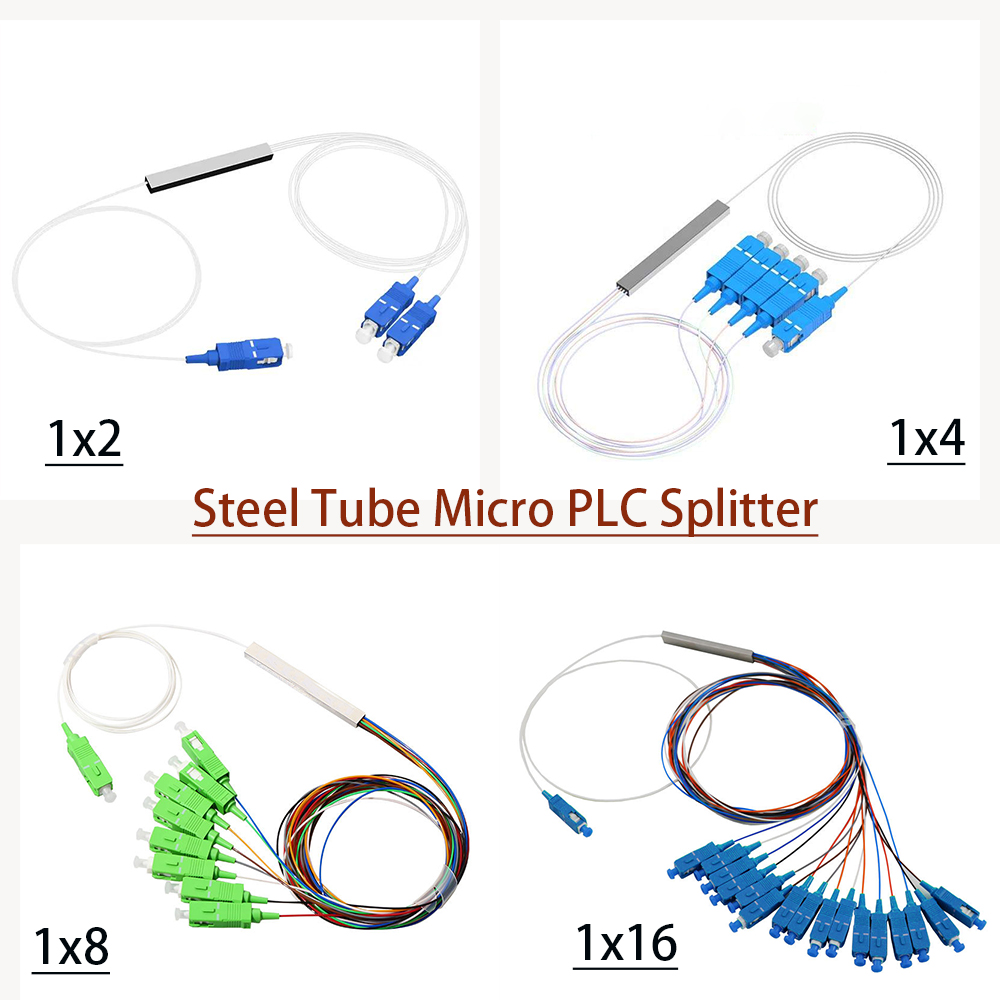
Although the outer appearance and size of FBT and PLC fiber splitter seem rather similar, their internal technologies and specifications differ in various ways. Over the past few years, splitter technology has made a huge step forward in the past few years by introducing PLC splitter. It has proven itself as a higher reliable type of device compared to the traditional FBT splitter. If high split counts, small package size, and low insertion loss are required, you are suggested to choose PLC splitter rather than FBT splitter
Although the outer appearance and size of FBT and PLC fiber splitter seem rather similar, their internal technologies and specifications differ in various ways. Over the past few years, splitter technology has made a huge step forward in the past few years by introducing PLC splitter. It has proven itself as a higher reliable type of device compared to the traditional FBT splitter. If high split counts, small package size, and low insertion loss are required, you are suggested to choose PLC splitter rather than FBT splitter